
Your electricity contract sets a maximum power, in kVA. As long as the appliances running at the same time stay below it, all is well. Above it, the whole home cuts out. That's what happens when an induction hob or electric heaters are added to a home still on an old contract.
Three parties are involved in raising that power, each with its own role. You make the request, to your electricity supplier. The meter and the main service breaker belong to Enedis, the network operator, and nobody else. We work out what you need and adapt what comes after the breaker: your panel and your circuits.
First, check that power is really the problem
Raising the power only fixes one fault: the whole home cutting out because you're going over what your contract allows. On a Linky meter, the screen then shows "PUISS DEPASSEE". With an older meter, it's the main service breaker that trips when several big appliances run together.
If it's a single breaker in the panel that trips, the problem lies elsewhere: the circuit is overloaded or faulty, and a bigger contract won't change a thing. See our page on a breaker that keeps tripping. And if it's an RCD that keeps tripping, it's a current leak you need to look for.
If it's been tripping since the Linky was fitted, there's an explanation, and Enedis gives it itself: an old, badly set breaker could let through more than the power in the contract. The Linky cuts at the contract's level. Your habits haven't changed, but the margin you enjoyed without knowing it has gone.
How much power you need
What matters is what runs at the same time. We draw up a power budget: we list your appliances, look at what runs together at the busiest times, a winter evening for instance, and add it up. To give you an idea, an electric heater draws 1 to 2 kW, an oven 2 to 3 kW, a washing machine or a water heater around 2 kW, and an induction hob can go over 5 kW with all its zones on. With 6 kVA, you reach the limit quickly.
Your customer account on the Enedis website also shows the power you've actually drawn. It's a good basis for not choosing at random.
There's no point aiming too high: the standing charge rises with the power, and you pay it every month. Sometimes there's a simpler answer than an increase. A water heater that heats at night, on off-peak hours, no longer competes with the evening oven. A load-shedding relay switches the heating off for a few moments when consumption nears the limit. We tell you what makes sense in your home after the power budget.
The request: you, through your supplier
The contract holder calls their electricity supplier, whether they own or rent. The supplier passes the request on to Enedis. With a Linky meter, the change can be made remotely, within 24 hours according to Enedis. Without a Linky, an Enedis technician has to come. The fee depends on the supplier: ask them, along with the price of the new contract.
Enedis also checks that your connection can carry the power requested. If it can't, work is needed on its side, paid for through your supplier, and the contract only changes once that work is finished. In an older building, the rising main can limit what you can get: we cover that on our old apartment rewiring page.
Switching to three-phase follows the same route, with more substantial work. It's only justified for big needs, as we explain on our house rewiring page. As for the meter itself, only Enedis can replace or move it.
What we do
Everything after the main service breaker is our job. Before raising the power, we check that the installation can keep up:
- the cable linking the main service breaker to the panel, whose cross-section must suit the new power;
- the RCDs, whose rating must handle the current that will flow through them;
- the way the circuits are split: an oven and a hob on the same line, or a panel that's already full, aren't fixed by changing your contract.
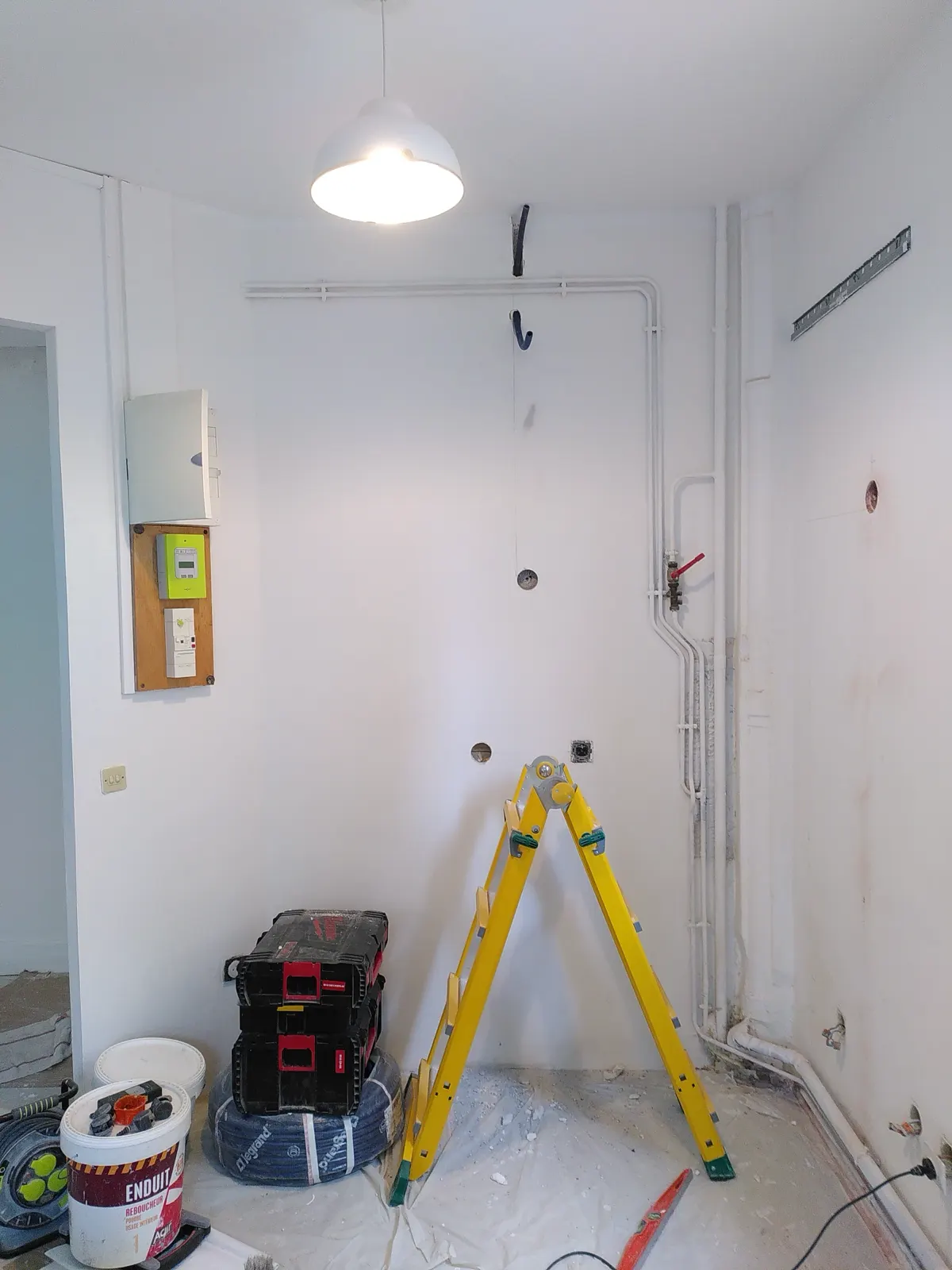
If the panel is too old or too small, we rework it: see our electrical panel replacement page. We can also move it, when it's in the way or during works, as long as we stay after the main service breaker. In a three-phase house, we spread the circuits across the three phases so that none saturates while the others are barely used.
What we never do is touch the main service breaker. It's sealed, it belongs to the network, and one mistake can cut the power to a whole floor. If it needs adjusting or replacing, Enedis does it. If anyone offers to "set it a bit higher", say no.
On price, adapting the panel is costed on a free quote, after a visit. If the panel needs redoing, we start at €400 incl. VAT per row, fitting and mainstream-brand equipment included. For a first opinion, call us or use our contact page.
Request your free quote. Reply within 48h, detailed quote within a week.
Request a quote