
An electrical panel doesn't break down: it ages. It keeps distributing power for decades without ever signalling that it no longer protects much of anything. That's exactly what makes it deceptive — everything works, so nobody looks at it. Here are the warning signs, what a compliant panel contains today, and how a replacement actually runs. For the wider picture, our electrical renovation page covers the whole subject.
The warning signs
Several can be spotted with the naked eye, without dismantling anything:
- Porcelain fuses or cartridges you replace by hand: your installation is at least thirty years old.
- No residual-current devices — the wider modules marked 30 mA that cut off when they detect a leakage current. Without them, personal protection isn't covered.
- Not one free slot: no way to add a circuit for a dishwasher or a radiator without starting over.
- No labelling at all: no tags, and nobody knows which breaker controls what.
- Loose wires, connector blocks, a wooden backing board: a long way from a DIN rail and a busbar comb.
There's also a functional sign, less visible but just as telling: a breaker that keeps tripping. A breaker that trips is doing its job. If it does it every week, a fault needs dealing with — sometimes in the panel, often elsewhere on the installation — and an RCD that keeps tripping calls for a proper leak search.
What a compliant panel contains today
Upstream of the panel sits the main service breaker, the sealed one next to the meter. It belongs to the network operator and nobody else touches it. Everything downstream, on the other hand, is the panel — and therefore our territory.
A panel compliant with NF C 15-100 is organised in three layers. First the 30 mA residual-current devices, which protect people by detecting leakage currents. We fit several, because circuits have to be spread across them: if one trips, the whole home doesn't go dark. Some appliances — washing machine, hob — require a type A device, more sensitive than the ordinary type AC.
Then the branch breakers, one per circuit, rated for what they feed: 16 A for a lighting circuit in 1.5 mm², 20 A for sockets and dedicated circuits in 2.5 mm², 32 A in 6 mm² for a hob. A lighting circuit doesn't exceed eight lighting points, a socket circuit twelve outlets.
Finally the physical layout: DIN rail, busbar combs, and a reserve of at least 20% free slots required by the standard — so the panel can evolve without being replaced.
A word on surge protection devices, often quoted as standard: they're mandatory in certain areas and on overhead supplies. In Paris, where the network runs underground, they generally aren't. We'll tell you if your case warrants one rather than adding it on principle.
How the replacement runs
The job always follows the same order. We cut the power at the service breaker and verify the absence of voltage before anything else — a panel is replaced dead, no exceptions. We then identify each existing circuit, remove the old panel, fit the new one, distribute circuits across the right residual-current devices, and label everything. Then come the checks: earth continuity, tripping of each RCD, insulation resistance, before bringing circuits back one by one.
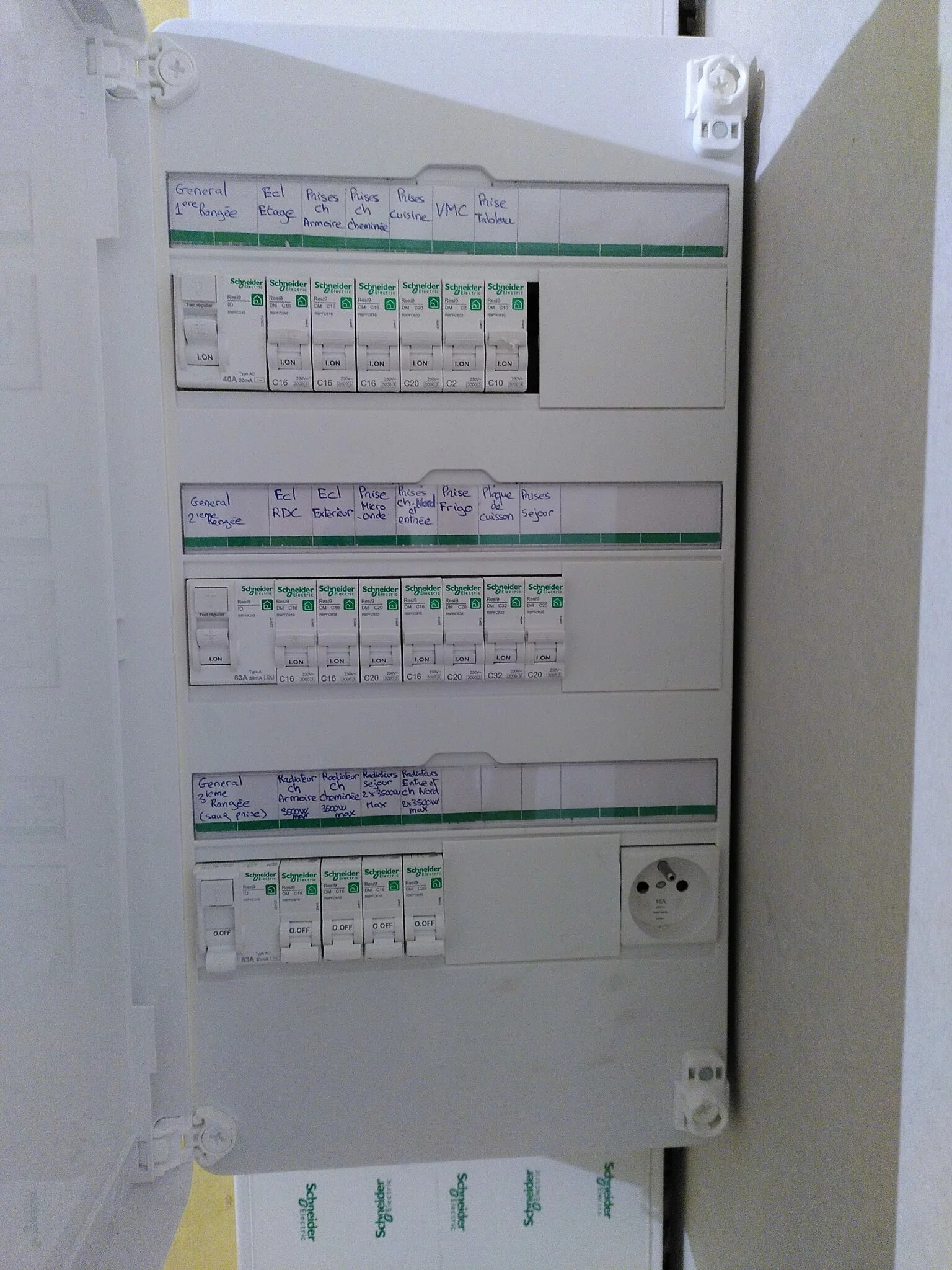
Allow half a day to a full day for a standard panel where the circuits are kept. And here's what usually surprises people: the real clock isn't fitting the panel, it's identifying the circuits. On an installation that was never labelled, working out what each outgoing way feeds frequently takes longer than the wiring itself. It's also what explains the gap between two quotes for what looks like the same job.
What an electrical panel replacement costs
We start at €400 incl. VAT per row, labour and standard-brand hardware included — Schneider, Legrand, Hager. A one-bedroom flat often fits on one or two rows, a family house on three or four.
Two things move the total: the number of circuits to create or rework, and the state of what arrives at the panel. If the wiring is sound and properly sized, we connect it; if it's damaged or undersized, full rewiring is the answer and is priced separately. The visit exists precisely to settle that before we quote a figure.
As with any work in a home over two years old, the reduced 10% VAT applies. Our page on electrical renovation grants covers the rest.
Two questions we always get
Do I need a Consuel certificate?
No, not for a straightforward panel replacement on a sound existing installation. A Consuel certificate becomes necessary when the installation is entirely redone, or when the meter has to be reconnected after a long cut-off.
Can I do it myself?
Nothing legally forbids a private individual from doing it in their own home. But a panel is replaced inside an enclosure that stays connected to the grid, and a mistake in distribution or rating doesn't show: you discover it the day the protection should have worked. After an incident, your insurer will ask who carried out the work. It's the kind of item where saving money gets expensive.
Finally, it's worth being clear about what a new panel does and doesn't fix. It brings modern protection and a clean layout, but a new panel doesn't correct what sits behind it: circuits without an earth stay without an earth, undersized cables stay undersized. In an older property, the panel is often the first step of rewiring an old apartment rather than the complete answer. To find out what the rules actually require in your situation, see our page on electrical code compliance.
Want your panel looked at?
Send us a photo of your panel with the cover off, or book a visit: ten minutes on site is enough to tell you whether it still holds up, needs a partial rework, or a full replacement. The assessment is free when it goes with a quote, and you get a detailed costing within a week.
If the panel worries you because the power keeps going, electrical troubleshooting is the better place to start. For ranges, our electrician pricing in Paris is public, and for anything else, contact us.
Request your free quote. Reply within 48h, detailed quote within a week.
Request a quote