In a building, the electrics of the common parts are the service everyone uses and nobody looks after — until they fail. They belong to the co-ownership, they're decided at the owners' meeting, and they engage the managing agent's responsibility. That framework changes how we work: a quote has to be readable by owners who aren't specialists, an intervention has to be justifiable, and emergencies have to be told apart from planned work. That's what we practise with residents' committees and managing agents across western Paris. For troubleshooting in general, see our electrical troubleshooting page.
What counts as common parts, and what doesn't
The rule is simpler than people think. Common is everything upstream of each flat's service breaker and everything serving several units: circulation lighting, the entryphone and street panel, the landlord-supply panel, plant rooms, the supply to the garage door or gate. Private is everything downstream of a unit's breaker — the flat's panel, its circuits, the entryphone handset inside the home.
One important exception: the rising main, which carries power from the foot of the building to each floor. Since the ELAN law of 2018, most have been transferred to the public network, and reinforcing them is Enedis's job, no longer the co-ownership's — we go into the consequences on our page about rewiring an old apartment. Knowing where common ends avoids a lot of disputed bills: it's the first thing we clarify on site.
The areas we work on
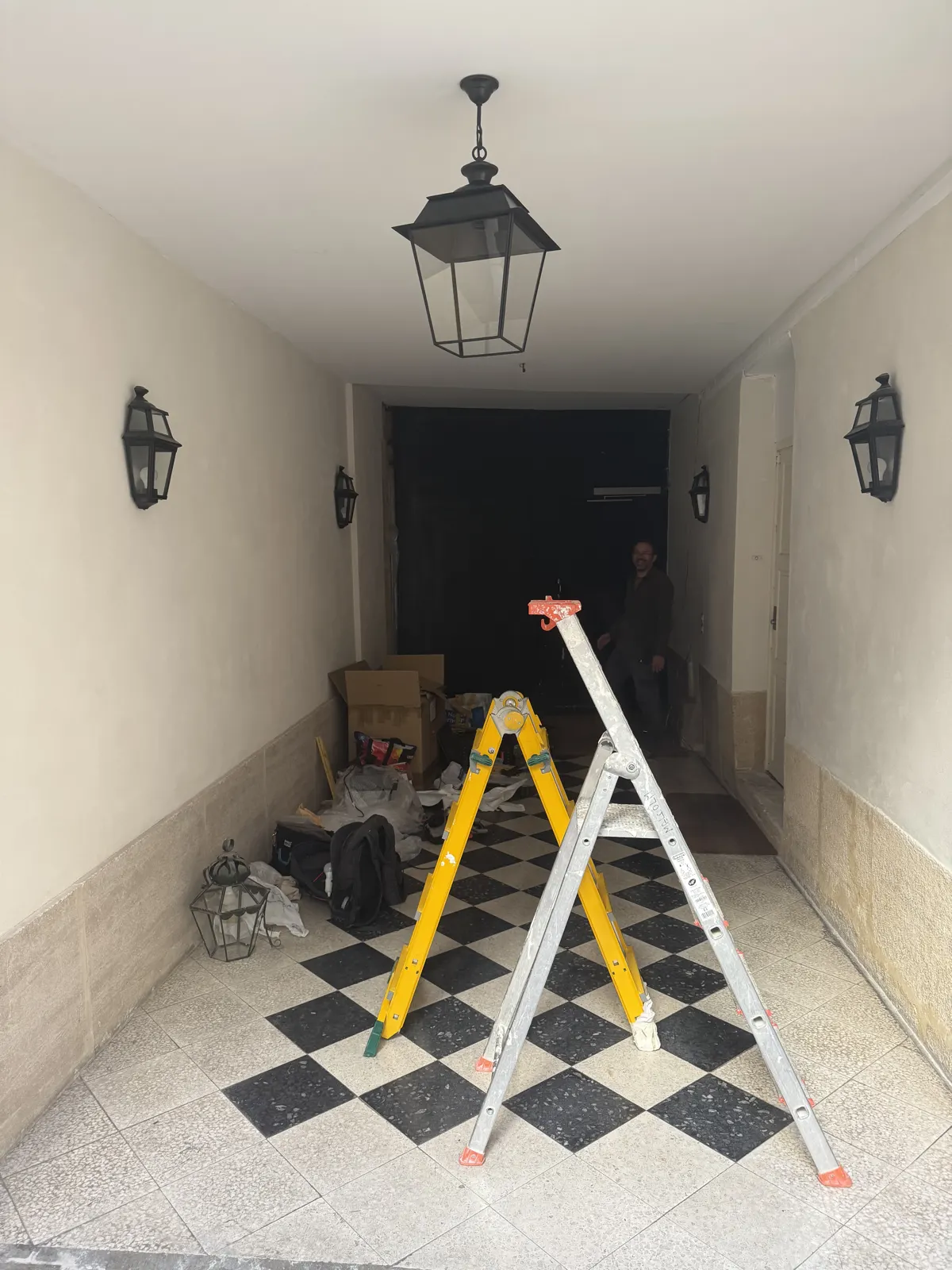
Circulation lighting. Stairwells, landings, cellar corridors, bike and bin stores, the entrance porch. It's the most frequent item, and the one with the most to gain: replacing incandescent bulkheads with LED fittings on presence detection divides consumption and removes the spots where the timer gives out before you've found your door. We size the detection to cover the actual route, not just the entrance.
Entryphones. Street panel, power supply, riser cabling, door release. An entryphone fault often hits the whole building at once, and the boundary between the private handset and the shared system is the question we're asked most — our page on intercom repair covers it in detail.
The landlord-supply panel. It's the building's own panel: it feeds the common lighting, the collective ventilation, the sump pump, the garage door. In older buildings it has often stayed on fuses, with no residual-current device and no labelling. Reworking it secures everything downstream and makes every later intervention easier.
Making the plant rooms safe. A damp bin store with exposed wires, a cellar where a cable runs across the floor, a plant room whose door closes on a makeshift installation: these are risks for the occupants and for the managing agent's liability. We treat them as priorities, not as comfort.
How it works with a residents' committee
We know a residents' committee is made up of volunteers who have to defend an expense in front of their neighbours. So we give them what they need to do it.
The visit first, with the caretaker or a committee member: we open the panels, walk the circulations, note what's a safety matter and what's an improvement. Then the quote, detailed line by line, with the two levels separated — what has to be done, what would be good to do — so the meeting can vote one without the other. Before-and-after photographs for every intervention, attached to the report. And a single point of contact from start to finish.
The quote is designed to be read by someone who isn't an electrician: no jargon without explanation, clear amounts per item, and answers to the questions we always get at meetings — why now, what happens if we wait, what guarantee.
Emergency or planned works
A stairwell in the dark or an entryphone out for the whole building is a callout: we come within 24 to 48 hours, on a simple call from the agent or the committee, under routine expenditure. A complete lighting rework or a panel to redo is works: it's quoted, voted, scheduled, and we fix the dates with the caretaker to disturb the occupants as little as possible.
In between, we offer co-ownerships that want it a regular visit — once a year, say — to check the panels and lighting before the fault rather than after. It's the committee's choice, never an obligation we impose.
We work in co-ownerships in the 15th, the 16th — Passy and Auteuil in particular —, the 7th and the western inner suburbs. When a building's installation is at issue beyond the common parts, our electrical code compliance page sets out what's required. Our electrician pricing is public, and you can contact us for a visit.
Request your free quote. Reply within 48h, detailed quote within a week.
Request a quote