
Older flats were wired at a time when people plugged in a lamp and a radio. And even in a recent home, the socket is never where the desk ended up. To add one, there are two questions: where does the power come from, and which way does the cable run?
Where the new socket is fed from
The simplest option is to start from a nearby socket. We extend the existing circuit to the new spot, provided it still has room. A socket circuit has a limit: twelve sockets if it's wired in 2.5 mm² and protected at 20 A, eight if it's in 1.5 mm² and protected at 16 A. A double socket counts as two.
When the circuit is already full, or the socket has to feed a large appliance such as a washing machine, a dishwasher or an oven, it needs a circuit of its own, run from the panel with its own protection. That's more work, and there has to be room in the panel. If it's full, we start by reorganising or replacing it: see our electrical panel replacement page.
Which way the cable runs
It depends on the wall.
In a hollow partition, plasterboard on a metal frame, we run the cable inside and fit a back box designed for that type of partition. No chasing, hardly any dust.
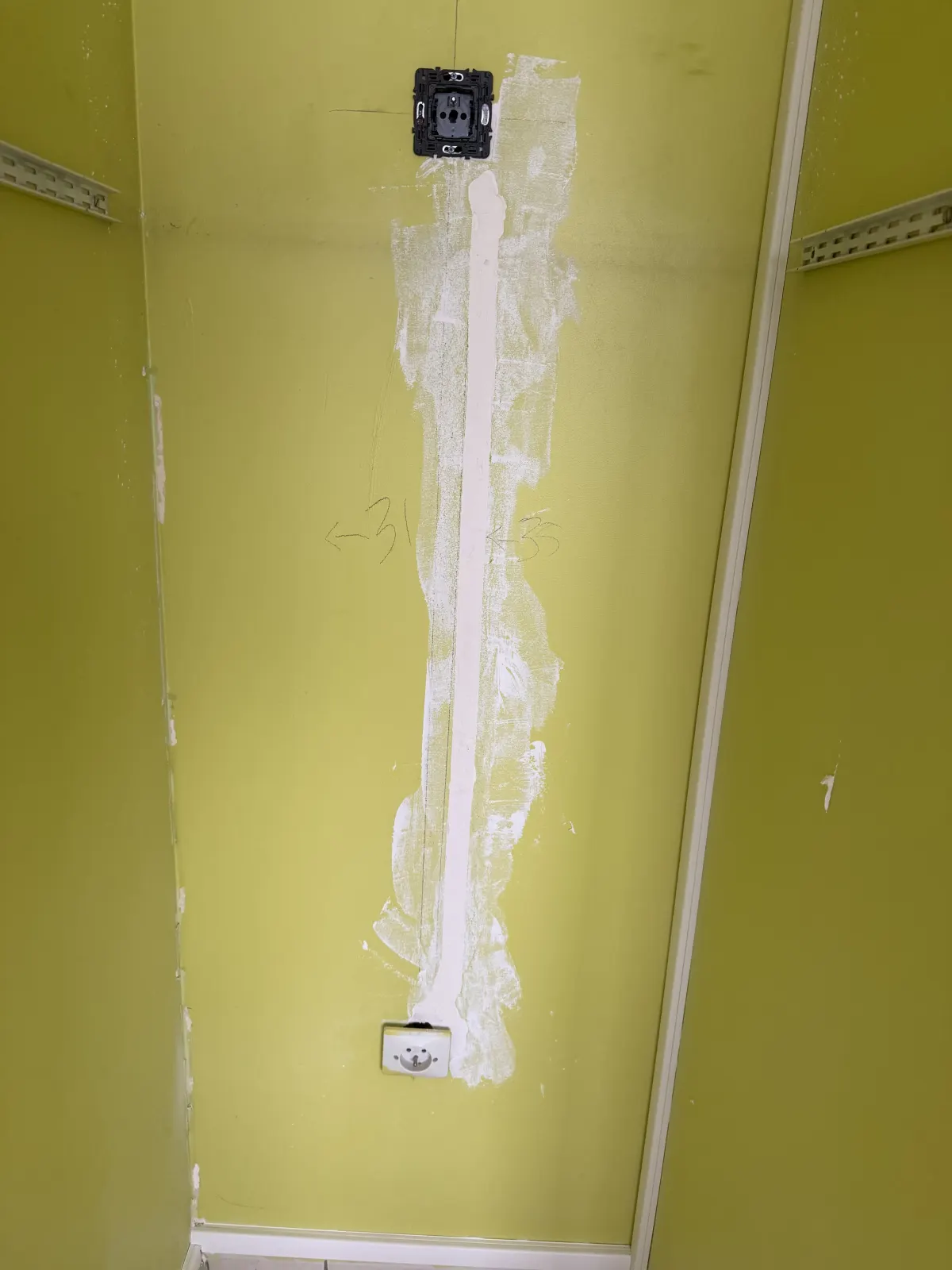
In a solid wall, brick, plaster or stone, we cut a chase, lay a conduit in it, then fill it in. Once repainted, it's the most discreet solution, but it's also the dustiest. And in an older building, you can't chase just anywhere: our page on rewiring an old apartment explains the precautions.
If you'd rather not touch the wall, there's surface mounting, in a moulding or trunking along the skirting or the ceiling. It's quick and easy to remove, but you can see it. In a rental or for a temporary need, it's often the right choice. And if you're replacing the skirting boards anyway, go for cable skirting: the cable runs inside, without opening anything.
The rules to follow
A socket isn't fitted right at floor level: there must be at least 5 cm between the finished floor and the centre of the socket, and 12 cm for the 32 A hob socket. In the kitchen, none go above the sink or above the hob.
In the bathroom, sockets stay outside the safety zones around the shower and bath. On a balcony or terrace, you need a weatherproof model, protected by a 30 mA RCD. And every new socket has an earth pin and shutters that stop a child pushing something into it.
Replacing a damaged socket
A socket that's cracked, doesn't hold the plug properly or has gone black needs changing. If it's stopped working altogether, read our page on a socket that isn't working first: the fault isn't always in the socket itself.
One trap to know about: replacing an old unearthed socket with a model that has an earth pin doesn't give you an earth. If there's no earth wire behind it, the pin isn't connected to anything. We'll tell you, and look at what your installation allows. In the meantime, the 30 mA RCD in the panel is what protects people.
What it costs
Replacing a socket on a sound installation usually fits within our €132 incl. VAT call-out, travel and first half-hour included. For an added socket, the price depends mainly on the route. Extending a circuit from the next socket inside a hollow partition has nothing in common with a new circuit run from the panel through three rooms. We price it once we've seen the wall and the panel, and you know the cost before work starts. We fill in the chases; the painting is still to be planned.
When sockets are missing in every room, adding them one by one isn't always the best idea. Our full rewiring page helps you decide. For a light rather than a socket, see lighting installation. Our prices are online, and for a quote, contact us.
Request your free quote. Reply within 48h, detailed quote within a week.
Request a quote